
Norway & Denmark / Young players
Take away Nordsjælland and Denmark still plays its young players more
Danish clubs gave under-21s a bigger share of league minutes than Norwegian clubs in every season since 2021, even without the country’s most youth-heavy club. But three of the four clubs that finished first or second in the final seasons gave them little time.
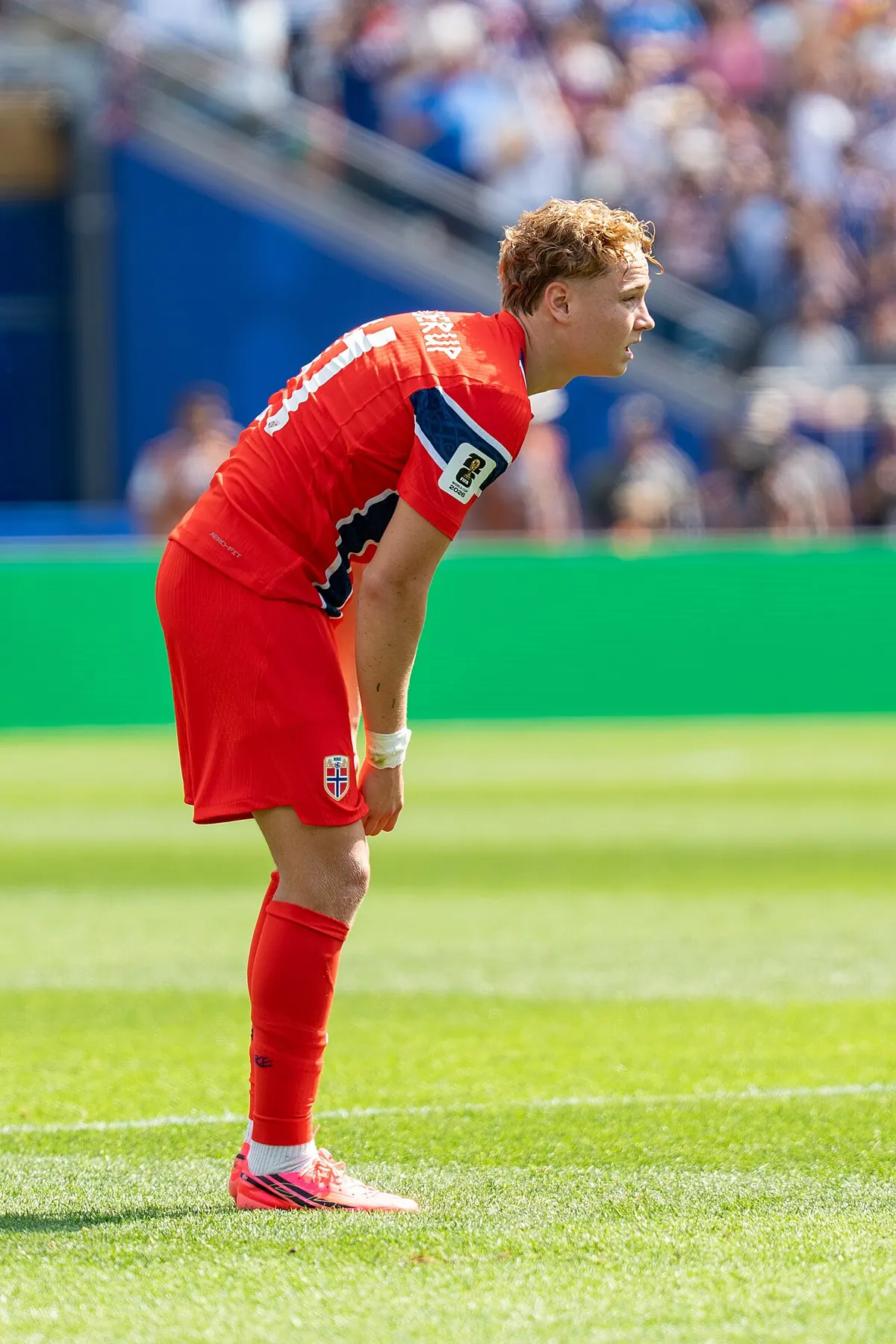
Photo: Bryan Berlin / WikiPortraits / Wikimedia Commons, CC BY-SA 4.0.
Scope. League matches only: the Eliteserien, 2021-2025, and the Danish Superliga, 2021/22-2025/26. Under-21s are players born in or after the year 20 years before the season opened (2005 or later for the final seasons). Cup and European matches are excluded. How we did this.
In this article
Andreas Schjelderup is Norwegian, but his route to senior football ran through Farum. He joined Benfica from Nordsjælland, then came back on loan in September 2023, and the club presented the move as a chance to play.
This article measures how often clubs give young players that chance. Across five completed seasons, under-21 players took 15.7% of observed league minutes in Denmark and 8.7% in Norway. The figures favour Denmark, though by less than the full-season gap suggests.
Nordsjælland widens the gap. It does not create it
Nordsjælland is the obvious objection. Under-21s took 52% of the club’s league minutes in 2025/26, more than any other club in either country. A league containing that club could look young even if nobody else played young players.
So we removed it: its young players’ minutes and all its team minutes. Denmark’s remaining clubs still gave under-21s a bigger share than Norway in all five paired seasons. In the final pair, Denmark falls from 15.8% to 12.5% without Nordsjælland, against Norway’s 10.0%.
The typical club tells the same story. Line each league’s clubs up by their share and take the one in the middle: Denmark’s middle club was ahead of Norway’s in every season, at 15.0% against 10.1% in the final pair.
Sources: [1]
How big the gap is depends on what you count
The direction is settled; the size is not. Count only Denmark’s 22-round regular season and leave out Nordsjælland, and the final-season share is 10.7%, just 0.7 percentage points above Norway. The rest of Denmark’s lead comes from the 10 split rounds, in which its clubs gave under-21s more of the minutes.
The age line matters too. Widen the group to under-23s of the league’s own nationality and the opening season reverses: Norway 20.2%, Denmark 18.5%. Denmark’s advantage is strongest for the youngest players, not for every stage of an early career.
Sources: [1]
The top clubs barely used them
The national averages hide clubs that tell opposite stories. Of the four clubs that finished first or second in the final seasons, three gave under-21s far less than their league’s share: AGF 3.5%, Midtjylland 6.6% and Bodø/Glimt 1.8%. Viking, Norway’s champions, were the exception at 12.7%, all of it to Norwegian players.
Nationality is a separate question. FC Copenhagen gave under-21s 8.1% of their minutes, but players with Danish nationality took only 0.9%. At the other end, Haugesund handed under-21s 22.5% while finishing bottom of the Eliteserien. Young minutes can be a choice, a necessity or a sales strategy; these figures show how many minutes there were, not why.
Sources: [1]
Norway made coach development someone’s job
Minutes are what a young player can count. The coaching behind them is harder to see, but Norway has written its approach down. Its academy-classification history describes shared football revenue paying for qualified development-coach posts, and later arrangements that gave eligible clubs a named responsibility for observing coaches, setting individual goals and following their work in training and matches.
Denmark’s system is documented in similar detail. The Danish FA’s youth licence manual sets staffing, coaching, education and wellbeing requirements, and rewards academies whose players establish themselves in senior football; its Future programme gives later developers a separate route. Neither country’s paperwork proves it caused the minutes above. Both show what a club can be asked about.
What a young player should ask
Schjelderup’s loan ended in May 2024, when he went back to Benfica. Going back to an earlier club need not be read as a step backwards; it was a route to the one thing a young player cannot develop without. The national figures show young players receiving a bigger share of minutes in Denmark. The club figures say it depends far more on which club, which role and which part of the season.
Three questions before a move
- Ask for the club’s under-21 minutes in recent seasons, and how many went to players of your nationality.
- Ask who is responsible for your development each week, and how they will review it with you.
- Agree what happens if first-team minutes do not come, before you sign.
How we did this
Minutes come from Fjordata’s league lineup and match records. A player counts as under-21 for a whole season if born in or after the year 20 years before the season opened. Nationality is the one listed by the data provider; it does not identify academy graduates. Danish seasons include the championship and relegation rounds unless stated; removing Nordsjælland subtracts both its under-21 minutes and its total team minutes.