
African talent / The next move
Loans kept African players close to home. Sales took them further
Of 52 identified loans of African players out of Nordic league clubs, 40 went to clubs in the same four countries. Other departures went much further, and a big-name signing did not always mean playing for the club that signed him.

Photo: Carlo Bruil Fotografie / Wikimedia Commons, CC BY 2.0.
Scope. Departures of players whose first nationality is African from clubs in the Danish Superliga, Allsvenskan, Eliteserien and Veikkausliiga, where the move could be identified. Moves that cannot be matched reliably are counted separately and not added in. How we did this.
In this article
Brighton signed Simon Adingra from Nordsjælland in 2022. His next club football was not in the Premier League but in Belgium, on loan at Union Saint-Gilloise. The contract said England; the pitch said Brussels.
That gap between where a player signs and where he plays shows up across the departures from the four leagues. Of 52 identified loans of African players out of the four leagues, 40 went to other clubs in Denmark, Sweden, Norway or Finland, 31 of them in the same country. (Iceland and the Faroe Islands, also Nordic football markets, are outside the data.) Of 103 other departures, 31 stayed in the region and 56 went further.
Loans stayed local. Other moves went abroad
Loans and other departures had different destinations
Identified outgoing records · club country, not destination division
Loans starting
52 records
- Within the four covered countries
- 40
- Same country
- 31
- Another covered country
- 9
- Elsewhere
- 12
- Without a club
- 0
Other departures
103 records
- Within the four covered countries
- 31
- Same country
- 22
- Another covered country
- 9
- Elsewhere
- 56
- Without a club
- 16
Loans ending
22 records
- Within the four covered countries
- 9
- Same country
- 5
- Another covered country
- 4
- Elsewhere
- 13
- Without a club
- 0
A loan was usually a step to another club in the same market, not an exit. The other departures are a mixed group, not all of them sales: releases, free transfers and undisclosed fees all appear, and 16 players were recorded as leaving without a club. We keep the 22 loan endings separate, because a player going back to his parent club is not a new move.
These are the moves we could verify. Another 129 cannot be matched reliably to these, so we leave them out rather than guess whether they duplicate them. Some sources also give a different first nationality for seven of the moves. Without those, the contrast holds: 35 of 47 loans stayed in the region, against 30 of 101 other departures.
Sources: [24]
The contract and the playing destination can differ
Adingra is not unusual. Brighton signed Malick Yalcouyé from IFK Göteborg in July 2024 and loaned him to Sturm Graz the following month. Victor Boniface went from Bodø/Glimt to Union Saint-Gilloise before Leverkusen; Mohammed Kudus went from Nordsjælland to Ajax before West Ham and Tottenham.
Three players, three routes onwards
Selected career stages confirmed by club reports

In Leverkusen colours, July 2026

With Côte d’Ivoire, June 2026
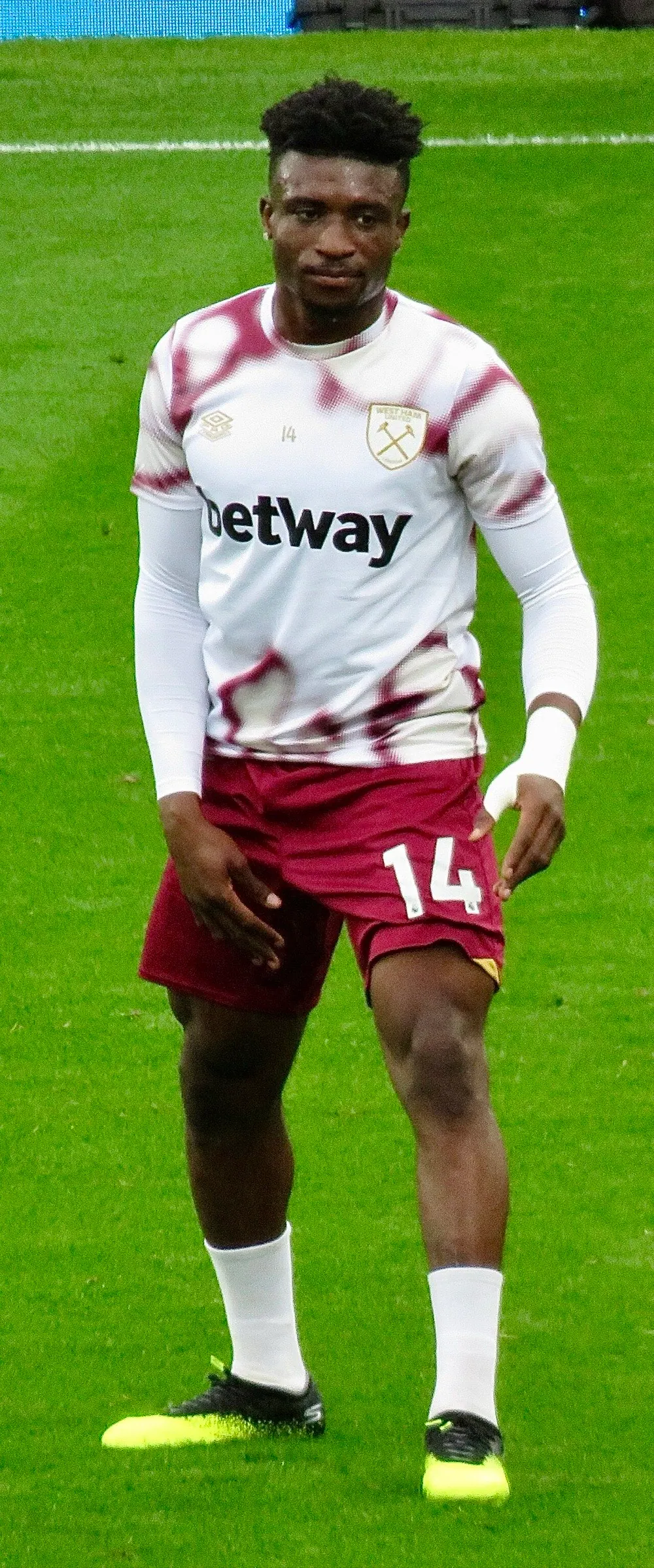
Then at West Ham, August 2024
Photos: Fuguito and Egghead06 / Wikimedia Commons, CC BY 4.0; Bryan Berlin / Wikimedia Commons, CC BY-SA 4.0.
These careers are examples, not a success rate. Kudus’s Danish spell came before the seasons this series measures. For an agent weighing a proposal, the question is which team the player would actually join, in which competition and role, and who decides whether another loan follows.
Where they came from matters as much as nationality
Arrivals tell the other half. Of 107 identified arrivals outside loans, 36 came from clubs in the four countries, 10 from Ghana and eight from Nigeria. A Ghanaian arriving from another Nordic club and one arriving straight from a Ghanaian academy share a label, not a recent football education.
Arrivals came through several football markets
Previous-club country · arrivals, excluding loans
Records labelled 2025 and 2026 in Norway, Sweden, and Finland; 2025/2026 and 2026/2027 in Denmark. These are shorter records than the performance comparison.


Vejle’s signing of Ransford Amoo in January 2026, from True Life FC in Ghana, is the second kind: an actual route, documented by the club, rather than one inferred from a passport.
What these departures cannot tell you
This analysis shows where players went next. It cannot give the odds of reaching Europe’s biggest leagues: an English club is not necessarily a Premier League club, and a permanent contract does not prove a player appeared in that competition. Before any move, ask what follows the signature: where the player will train, which team can pick him, and when his progress will next be reviewed.
Check the selection and coverage
The identified departure records use the provider’s primary-nationality classification in the selected snapshot. 7 records change that classification between stored copies. Excluding all those records leaves 35 regional loan departures out of 47, compared with 30 regional other departures out of 101. The direction of this comparison remains the same.
An additional 129 outgoing record views lack stable event IDs and are excluded from this graphic. They may overlap identified events or one another. They are not 129 proven additional transfers. The identified subset cannot establish a representative destination probability.
Entries with conflicting move descriptions are also excluded before assigning a transfer type; they are not added as separate transfers.
Stored window labels are 2026 in Norway, Sweden, and Finland, and 2025/26 and 2026/27 in Denmark. They do not supply individual move dates. The transfer coverage is therefore shorter than the five completed performance seasons, and we do not infer a sequence or journey from adjacent records.
Read the analysis evidenceSources: [24]
Explore the numbers
Open the tables for club and player comparisons, or read how the data was selected.
About the data
Performance figures cover domestic top-flight league matches in Denmark, Sweden, Norway, and Finland. Cup matches and European club competitions are excluded. Data comes from FBref through Fjordata, our Nordic football dashboard, checked on 14 October 2026.
- Allsvenskan: completed seasons 2021 to 2025.
- Danish Superliga: completed seasons 2021/2022 to 2025/2026.
- Eliteserien: completed seasons 2021 to 2025.
- Veikkausliiga: completed seasons 2021 to 2025.
The current seasons, 2026 and 2026/2027, are shown separately where included. Iceland is left out because equivalent performance data is unavailable. African players means players whose first nationality in the source is an African country; it does not describe ethnicity or where they grew up.
Minutes shares use all recorded player minutes. The age comparison uses a player’s recorded season age, rather than age on arrival, and counts each league season separately. Players can appear in more than one season. Five names have inconsistent birth-year records: Adama Fofana, Fallou Ndiaye, Ibrahim Cissé, Ibrahim Osman, Maissa Fall. Their minutes remain in the league totals, but their uncertain records are excluded from age comparisons and named rankings.
Transfer records come from Transfermarkt through Fjordata, checked on 12 October 2026. Their history is shorter than the performance history. The country charts include identified moves outside the loan categories, remove repeated records, and separate “without a club” from country destinations. Vejle’s original announcement supplies Ransford Amoo’s missing previous club and country. A move between covered leagues can appear from both sides. A club’s country does not identify its division.
Official club announcements support the selected career stories, including loans. These examples are not a complete list of everyone who moved. The data cannot measure how much a Nordic move improved a career or predict an individual’s destination.
Download the analysis data
CSV files for readers who want to reuse or check the figures.